
Notes for Gemelo 5
There are usually one or two points of interest in an Observer barred puzzle, and here we pick them out for comment. Please feel free to add your own questions or observations on any aspect of the puzzle (including clues not listed below) either by using the comment form at the bottom of the page or, if would prefer that your question/comment is not publicly visible, by email.
Gemelo 5 Plain
Solver difficulty rating
3.5 based on 43 votes (voting is now closed)
Please give your own G-rating for this Gemelo puzzle by clicking on the relevant star above, with one star representing a very straightforward solve by your own standards (Gentle) and five stars indicating a seriously tough one (Ghastly). If you accidentally select the wrong star, you can change your vote by simply clicking on a different one. Each solver will be using their own yardstick, but by reflecting the average solver rating for the preceding puzzles I hope in the coming weeks to be able to give a good feel for the relative perceived difficulty of the latest offering. Note that hovering over the ‘graph’ icon will show you the full breakdown of votes for the current puzzle.
Last week’s puzzle achieved an average G-rating of 4.2 – no 1’s or 2’s (Mark Goodliffe clearly wasn’t among the voters), a handful of 3’s, and plenty of 4’s and 5’s. That struck me as being a very fair assessment. It will be interesting to see how the rating for this week’s puzzle compares.
For myself, I thought that the puzzle was very clever and Showcased (geddit?) the setter’s skills, but I’d rather have a ‘special’ that demands something different from the solver as well as the setter – the most recent puzzle of that type was Azed 2,750, since which we’ve had 24 ‘straight’ solves. The clues were generally sound, but the twisting and twiddling required to accommodate the film titles resulted in occasional looseness, and anyone who wasn’t keen on the deceptive capitalization of letters in a couple of clues last week will have been close to apoplexy this time around. I’ve covered the normal 8+8 clues below, but just let me know if you’d like me to comment or provide assistance on any others.
Setters’ Corner: This week I’m going to look at clue 18a, “Covered in grime from Shakespeare in Love missing cheerio, sadly (6)”. This is an anagram (‘sadly’) of CHEERIO without (‘missing’) the usual single-letter representation of ‘love’, the answer being a Shakespearean word meaning ‘smoky’ or ‘grimy’. The question here surrounds the fairness of the italicized text ‘Shakespeare in Love‘. The formatting appears to mark these three words out as a single unit, but in the cryptic reading they belong to three different parts of the clue – ‘Shakespeare’ is part of the definition, ‘in’ is a link from the definition to the wordplay, and ‘love’ marks the start of that wordplay. Is it desirable for clues to feature typography such as this which is clearly intended to deceive the solver? In general, I would say ‘no’; however, there is a theme running through every clue in this puzzle, with all the film titles being shown in italics. I think that it is therefore reasonable in this specific instance to expect the solver to mentally remove the italics en masse and also to be prepared to eliminate unwarranted capitals when addressing the cryptic readings. The clues that I’ve commented on below are shown without the italics.
Across
13a Is Argo’s final ordeal almost providing line of brightness? (6)
The letters IS (from the clue), the last letter (‘final’) of ‘Argo’, and a four-letter word for one heck of an ordeal, lacking its last letter (‘almost’), combine to produce a word for a contour line linking places receiving equal amounts of sunshine.
14a How Gigi might represent one performance by way of reply? (8, 2 words)
When the word GIGI is cryptically manipulated by the (2,6) answer, it could furnish (ie ‘How Gigi might represent’) a (1,3) expression equating to ‘one performance’.
21a Obscure Eastern cut including coat from Ben-Hur (7)
The usual abbreviation for ‘Eastern’ and a four-letter word for ‘cut’ (as I hope that my lawn will be by the end of the day) contain (‘including’) the outer letters (‘coat’) from ‘Ben-Hur’. When the film debuted in 1959, Mort Sahl famously observed, “Love him, hated Hur”.
23a Ed’s spare Green Book joke (7)
A charade of a three-letter word for ‘green’, the single-letter abbreviation for ‘book’, and a three-letter word for a joke, almost always seen in a question along the lines of “Have you heard the ??? about the bishop and the crossword setter?” The answer is shown by Chambers as being Spenserian, hence the “Ed’s”.
26a Makes up for deficiencies while screening Lawrence of Arabia, initially carrying on (6)
A matryoshka of a clue, where a two-letter word for ‘while’ contains (‘screening’) the initials of Mr Lawrence (and, latterly, of his alter ego Mr Shaw), which themselves contain (‘carrying’) the letters ON (from the clue).
27a Characters beyond the first three in Rebecca rejected at all times (3)
The letters (‘characters’) in the word ‘Rebecca’ which are not within (‘beyond’) the first three positions in the alphabet (‘the first three’) are reversed (‘rejected’).
29a Written fragments of An American in Paris: the lost act (8)
The letters AN (from the clue) are followed by the usual single-letter abbreviation for ‘American’, a French word for ‘the’ (in Paris: the’) and an anagram (‘lost’) of ACT.
33a Cult figure, burning to quit Oliver!, remains unchanged in this year (6)
A four-letter word for ‘burning’ is omitted from (‘to quit’) OLIVER, with the residue preceding a two-letter word meaning ‘remains unchanged’ and an abbreviation of the Latin for ‘in this year’.
Down
2d Overthrow barb with note supporting reaction to The Sting? (8, 2 words)
A five-letter word for a barb comes before the usual abbreviation for ‘note’ after (‘supporting’) a two-letter interjection which would be a likely response to a sting from a wasp or the like.
3d Reserve fund for opposite of The Sound of Music (4)
A double definition clue; determining whether ‘an interval of silence in music’ is the ‘opposite of the sound of music’ is left to the reader as an exercise.
5d Mock title of what would have been cut in The Life of Emile Zola? (7, 2 words)
The (3,4) answer satisfies the definition and also describes what, for a nineteenth century author, would have been essential tools of their trade, and would invariably feature a cut to enable variation in the flow of ink.
7d Pieces of eight distributed, having lost Grand Hotel manuscript (5)
An anagram (‘distributed’) of EIGHT, without (‘having lost’) the usual abbreviation for ‘grand’ and the letter represented in the NATO phonetic alphabet by ‘Hotel’, is followed by the two-letter abbreviation for ‘manuscript’.
12d He sculpted it, a nuisance about to upset stunts from Wings? (10)
A reversal (‘to upset’) of five elements – the two-letter abbreviation of the Latin for ‘he sculpted’, the letters IT (from the clue), the letter A (from the clue), a four-letter ‘nuisance’, and a single-letter abbreviation for ‘about’ (one of those which appears in Chambers but I have never seen ‘in the wild’).
19d Where paper is polled ahead of English Patient (8)
A three-letter word meaning ‘with close-cut hair’ or ‘polled’ precedes the usual single-letter abbreviation for ‘English’ and a word for a person under medical treatment. The answer is shown as hyphenated, 4-4, by the OED, but Chambers gives it as a single word.
20d Uplift Terms of Endearment alumni and staff in no way (7, 3 words)
A reversal (‘uplift’) of the last letters (‘terms’) of ‘Endearment’ and ‘alumni’ and a five-letter word for the sort of staff that might change hands several times in the course of a single lap.
22d Unfortunate struggle to cut Casablanca’s climax and make an impact (6)
A three-letter ‘struggle’ or ‘conflict’ deprived of (‘to cut’) the last letter (‘climax’) of ‘Casablanca’ combines with a word that has a figurative meaning of ‘to make a deep or irremovable impression’ (in which sense it usually appears in the passive voice) to produce a noun which might, somewhat tautologically, be seen preceded by an epithet such as ‘miserable’.
(definitions are underlined)
As for the film titles, I rather thought (at 5d), “Quills” might have been slightly better than “The Life of Emile Zola”??
Hi Trovatore, and welcome to the blog
Yes, that would have been rather more to the point. Sad(e)ly the film wasn’t even nominated for the Best Picture award.
I don’t have an issue with misleading italics where a setter has managed to work a reference into a clue, even where split between wordplay and definition. We usually commend a setter’s skill if they disguise the break between definition and wordplay in what in the surface reading appears to be a compound noun (e.g. “table spoon”, “dog collar”) and equivalents. Italics to mark the title of a work strike me as being a variation on this theme.
Hi Jonathan
I think it’s something of a grey area. The important thing with any clue is that a solver is able to interpret the clue as written in order to arrive at the answer; what the surface reading appears to say is irrelevant. A clue that requires the consecutive words ‘table spoon’ to be treated independently is perfectly fair; a clue which includes the word ‘tablespoon’ but needs to be read cryptically as ‘table spoon’ is unfair. Likewise a clue that includes punctuation which does not ‘work’ in the cryptic reading, eg writing ‘first, of course’ when indicating the letter C.
In my view, the unnecessary capitalization of words in the wordplay lies close to the border between misdirection and unfairness; ‘Ben Stokes looks sickly (5)’ for PEAKS seems ok, but in the cryptic reading ‘Stokes’ should be ‘stokes’. Misleading typography seems to me broadly similar – by using italics which are inappropriate in the cryptic reading, the setter is effectively telling the solver, “I have highlighted these words because they should be treated as a group…except that they shouldn’t” But I have no problem whatsoever with Gemelo’s puzzle here, where the italics are just there to highlight the film titles, and the solver can ignore them en bloc while admiring the setter’s skill at working a title into every clue.
Hello Doc
Enjoyed the puzzle and filled it in (correctly, I think). Lawrence of Arabia got me, hence in your clinic today. I wanted to know the reason behind the answer, which you explained nicely, of course. Thank you.
I’m not worried about typography or punctuation misleading me – I was ready for anything with Azed and even readier with Gruffalo. He’s a little terror, isn’t he? But a nice one and we’ll get used to his tricks, hopefully.
I just wondered again why he makes things hard for himself – it didn’t matter to me that each clue contained a best picture Oscar winner – could have solved them just the same without knowing that. Anyway, it is lovely to know he must really enjoy compiling the crossword. Great stuff.
A little terror indeed, and the fact that he can produce 36 impressive clues each containing the name of a Best Picture winner suggests that he may have a few more weapons up his cruciverbal sleeve 😨.
Slightly more accessible than usual, though I would never have got 12D without your hints. The “St Petersburg” at 8D was at first baffling as I could see the artist but had the wrong country!
Frustrating in that despite completing it, I am still unable to disambiguate a couple of the clues:-
17A – I have the definition as “Top” – but no idea about the wordplay.
32A – Defined as “plant”, but despite taking the ‘fr’ out of “Africa” I still can’t see it!
Any help please?
Yes, it’s Mr Trump’s St Petersburg rather than Mr Putin’s.
17a Top placed, obliterating Patton is second position (4). The wordplay has a four-letter word meaning ‘placed’ or ‘put down’ losing (‘obliterating’) the second letter of ‘Patton’ (‘Patton in second position’).
32a Frequently Out of Africa just about reflected plant (6). AFRICA with the two-letter abbreviation for ‘frequently’ removed (‘out’) is followed by the two-letter abbreviation for ‘circa’ (‘just about’) and the whole lot reversed (‘reflected’). The word ‘just’ is not required in the wordplay, and although ‘just about’ is fine for ‘circa’ one could question whether it is valid for the abbreviation thereof – it’s no worse than ‘artist’ for RA though.
Hope that clarifies things
Thank you – I will sleep better now!😊
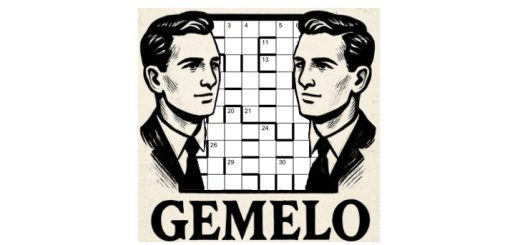
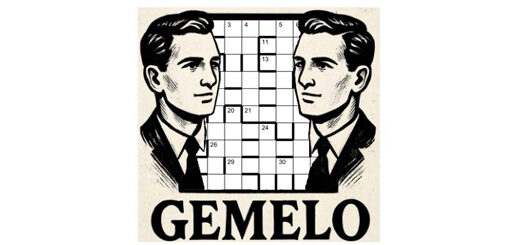
My thanks are due to Tony McCoy O’Grady, who has kindly updated ChatGPT’s ‘Gemelo’ image to feature a barred puzzle rather than a blocked one. Much more appropriate.
…and not just any old barred grid, but the one from today’s Gemelo 5.
Gosh – well spotted! let’s hope Gemelo keeps the same grid for no. 6 onwards… 😉
I enjoyed this and thought it somewhat easier than last week. A friendly grid with perimeter clues that yielded early on and so presented a variety of ways into the puzzle. I did wonder if Gemelo needed to tell us that each clue contained a best picture Oscar winner or perhaps we could have discovered this for ourselves. The title of the puzzle “Special Mentions” would have been a clue that something was there to be discovered.
I quite agree. The name of the puzzle – and the italicized titles in all 36 clues – would have been plenty.
I think the cleverest clue is 9a – the film title tells you everything you need to know really! I thought this puzzle was the easiest offering from Gemelo so far.
Yes, that one was my favourite. I think that the number of anagrams, hiddens and letter selections required to accommodate the titles worked in the solver’s favour.