
Notes for Gemelo 13
There are usually one or two points of interest in an Observer barred puzzle, and here we pick them out for comment. Please feel free to add your own questions or observations on any aspect of the puzzle (including clues not listed below) either by using the comment form at the bottom of the page or, if would prefer that your question/comment is not publicly visible, by email.
Gemelo 13 Plain
Solver difficulty rating
3.3 based on 50 votes (voting is now closed)
Please give your own G-rating for this Gemelo puzzle by clicking on the relevant star above, with one star representing a very straightforward solve by your own standards (Gentle) and five stars indicating a seriously tough one (Ghastly). Note that hovering over the ‘graph’ icon will show you the full breakdown of votes for the current puzzle.
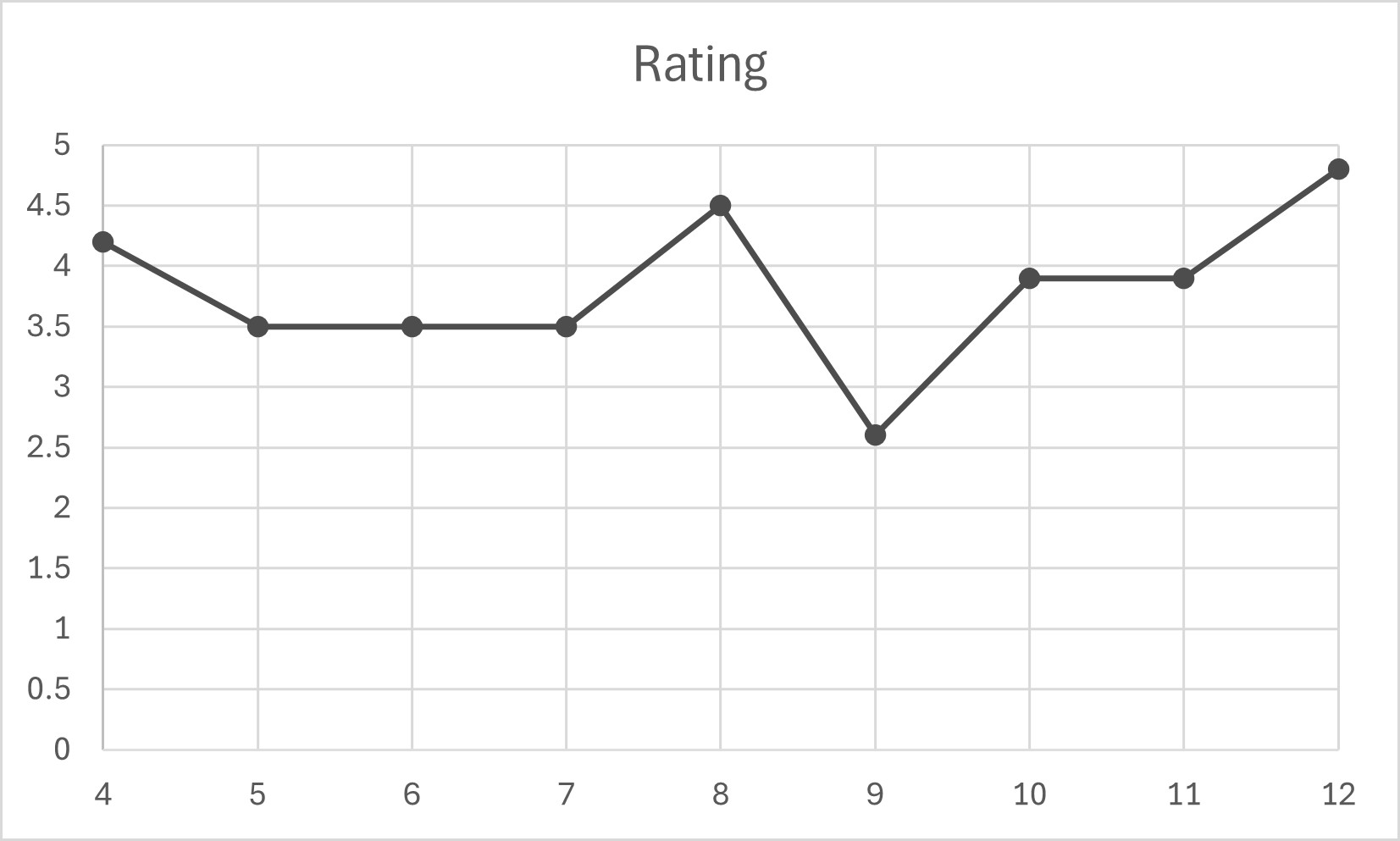
Last week’s ‘special’, the first Gemelo puzzle which has placed extra demands on the solver rather than just the setter, was rated as his toughest offering so far – your scores were all 4s and 5s, with the 5s comfortably in the majority, resulting in an average of 4.8. I too thought it was a tough puzzle, although it seemed like one of those which yielded gradually to prolonged attack, the wordplays being tricky but not fiendish, and most of the definitions being relatively direct. Your average ratings for puzzles 4 to 12 are graphically illustrated below:
Today we have a ‘plain’ to contend with, and it’s not without its challenges – I shall be interested to see what you make of it. There were no fewer than four &lits, which is an unusually high number. We’re starting to get used to a few of Gemelo’s little trademarks, including the ‘side’ in 28d (although I’m not sure that it’s appropriate in this instance). I marked 24 clues as being potentially worthy of comment, so if I’ve missed out any that you’d like me to say something about just let me know.
Setters’ Corner: This week I’m going to look at clue 33a, “Noble old pets not having time to tour state capital (8)”. A six-letter archaic word for ‘the sulks’ (ie ‘old pets’) is deprived of the usual abbreviation for ‘time’ and put around the three-letter name by which a South American state capital (and a regular visitor to crosswords) is commonly known. We all, I suspect, have our particular bêtes noires when it comes to cryptic elements of crosswords, and I probably have more than my fair share. One that I particularly dislike is ‘tour’ to indicate containment; I can’t accept that it ever has that sense in real life. I don’t dispute that ‘touring a lake’ implies a journey round the outside of the lake, but ‘walking the lake’ carries the same implication, and ‘walk’ is surely not a valid containment indicator. Perhaps more importantly, though, the act of touring involves being in a single place at any given time, which rules out being both sides of something simultaneously. That, while suitably cathartic, is not my point, which is that I doubt whether any other solvers will have batted an eyelid, simply saying to themselves, “Ah, ‘tour’ – containment indicator!”, which is (give or take a word) what I thought too. So why should a setter not use an indicator which will be perfectly well understood by their solvers, irrespective of its validity when placed under scrutiny? I think that this is entirely between the setter and their conscience – it is my choice never to use ‘touring’ to indicate containment, but if using ‘artist’ for RA made for a nice clue, I would include it, despite some misgivings about its accuracy, simply because it is such an established part of the language of cryptics. Fundamentally, if your audience will understand what you are saying and won’t be displeased with the way you say it, then there’s a strong argument for it being acceptable.
Across
9a Killer that’s annoying Batman villain (8)
A four-letter exclamation meaning “That’s annoying[!]” is followed by the name of a Batman villain who was not introduced until 1993. He derives his strength from a super-steroid called Venom, which would surely make him a dangerous opponent should he decide to participate in the Enhanced Games.
9a Pay poet to remove introduction (4)
The poet whose mononym loses its first letter (‘to remove introduction’) is the only Italian one that crossword setters and solvers need to know about.
14a Bit of blood that may be seen after shedding foul skin (3)
When a four-letter word meaning ‘foul’ is stripped from the outside of (ie ‘after shedding foul skin’) a seven-letter word meaning ‘that may be seen’, what is left is a word that might somewhat obliquely be defined as a ‘bit of blood’, being a person with a blood relationship to another.
16a Extremely slowly covering a few centimetres? (6)
The first of the ‘&lit’ clues, where the entire clue serves as both wordplay and definition. Here the first and last letters (‘extremely’) of ‘slowly’ contain (‘covering’) a word for a measure of length roughly equal to 5.5cm (or a term for a fastening often used to join pieces of wood). The name given to the measure, which is one sixteenth of a yard, is of uncertain origin, but it seems possible that one sixteenth of the distance from the end of the yard-stick may have been marked by the thing in question. On the subject of bêtes noires, the use of ‘extremely’ as a first/last letter selection indicator is another of mine, and one which I share with Azed.
26a Cross German off Harvard’s list of courses (6)
The single-letter abbreviation for ‘German’ is removed from (‘off’) the American (hence “Harvard’s”) word (with its American spelling) for a list of university courses (or a list of pretty much anything else).
31a I see starboard of old salt (6)
The letter I (from the clue) is followed by a four-letter word meaning ‘[to] see’ or ‘go out with’ placed to the right (‘starboard’) of the usual abbreviation for ‘old’.
Down
1d Native American hiding cash in Georgia under solid stone (12)
A three-letter word for a particular Native American people (think Brigham Young’s state) contains (‘hiding’) the four-letter name of the standard monetary unit of Georgia (ie ‘cash in Georgia’), the combination being preceded by an adjective meaning ‘solid’ or ‘total without deductions’.
2d Carrying off kind of music like Vivaldi’s Spring (6)
The kind of music that you might associate with Eminem or 50 Cent is followed by a (2,1) expression which indicates the key of Vivaldi’s Spring from (but not by) The Four Seasons. I know little of such things, and there seemed to be two possibilities (although one would properly have meant the definition having a qualifier to show its obsoleteness). A quick Google search confirmed that the key wasn’t G, and the definition was spot-on as it stands.
3d Ridges in finely-jointed masonry abandoned by House of Lords (4)
A six-letter word for a square hewn stone, or finely-jointed masonry made from such stones, loses (‘abandoned by’) the two-letter abbreviation for the House of Lords.
7d This will get you out in company without dress (5)
Last week it was a ‘number’, this week it will ‘get you out’ – it’s produced when an eight-letter word meaning ‘in company’ is stripped of a word meaning ‘[to] dress’, now almost always seen compounded with ‘up’ or ‘out’; the noun, meaning, clothing, invariably appears in the plural.
10d Try – when missing ‘hot’ in Mexican food – this? (7)
This &lit has an informal four-letter word for a try or attempt (only given by Chambers as part of a specific expression) having the usual abbreviation for ‘hot’ removed (“when missing ‘hot'”) and being inserted into a thin rolled pancake associated with Mexican cuisine.
12d Material used to cover Mark and John? (6)
The usual abbreviation for ‘mark’ is followed by the first name of the artist formerly known as Reg (‘John?’). I think I would have preferred ‘for covering’ rather than ‘to cover’, which doesn’t have a suitable intransitive sense.
17d Made out spring of water, wise when there’s hard water everywhere (6, 2 words)
I think there may be something in Gemelo’s contract that says he always has to produce a difficult clue for this phrase. Today it’s an approximate homophone (‘made out’) of a three-letter word for ‘spring of water’ (or a peeper) and a four-letter word for ‘wise’.
19d For The Globe – it’s plausible? (7)
This is a nice clue. A charade of a three-letter word meaning ‘for’ and a four-letter word for a globe produces a Shakespearean word, perhaps an alteration of a familiar eight-letter word, which makes its only first-team appearance in Othello: “When this aduise is free I giue, and honest, ??????? to thinking, and indeed the course To win the Moore againe.” It sounds to me more like an impressive new name for padel.
25d Primarily despicable plebeian from down under? (5)
The first letter (‘primarily’) of ‘despicable’ and a reversal (‘from down under’) of a word for a plebeian, or a coarse, ill-mannered person, combine to produce a word which is pretty neatly defined by the whole clue.
29d Offer price? Idle to give an example (4)
Nudge nudge, wink wink…the actor/comedian is indeed an example of a person who bears this name. The ‘offer’ in the definition is a whimsical indication of someone who (in the US vernacular) ‘offs’ people in the same way that an ‘icer’ might. That makes we think – could ‘resurrector’ be defined by ‘de-icer’? Don’t be surprised to see that one appearing before too long.
(definitions are underlined)
So sorry Doctor C, I meant 32 not 31! If I can’t even get that right , there’s little hope of me finishing!
!😀
32a is a double definition – the ‘Legally take away the right of’ is pretty obscure (Chambers shows it as ‘law; historical’), but the ‘striking’ is much more familiar, being the sort that comes from bells.
Hi Doctor C, I’m struggling with 31- I have 3 letters but can’t see it. Help!
Hi Iain
You need to put the letter I from the clue in position 1. Into positions 3-6 goes a four-letter word meaning ‘to see’ in the sense of ‘to court’ or ‘to go out with on a regular basis’. That is placed to the ‘starboard’ (right) of the letter in position 2, which is the usual abbreviation for ‘old’. So the answer is I + the abbreviation for ‘old’ + the word meaning ‘see’, and the answer is the name of a particular (chemical) salt. Hope that helps.
Also stuck on 5D for which I have the answer but cannot see the Abba reference.
Hi MP
5d Make bloody English necessary for Abba (6). The three-letter abbreviation (not the single-letter one) for ‘English’ is followed by the name of a three-letter Swedish monetary unit (‘necessary for Abba’, ‘necessary’ being an informal term for money). Although Anni-Frid grew up in Sweden, she was born in Norway – but in any event they use a unit with a similar name there, except that the first letter is an ø rather than an ö. Hope that helps.
Thank you for that. “Necessary” = “money” is a new one for me, very crafty!
In the olden days —paleolithic— we might have said something like ‘Have you got the necessary?’ meaning ‘Do you have any cash?’ or ‘Are you paying?’
I thought that Abba (sic) should more properly have been written as ABBA.
I think that’s a very fair point – I would say that capitals are de rigueur, with the reversal of the first B optional.
25 down was a new one on me (I wonder if Anthony Burgess had it in mind when writing A Clockwork Orange?). Galah and Drongo seem to be more commonly used.
Hi Tim
That’s interesting (I remember ‘drongo’ from Neighbours!). I don’t know about the antipodean words, but in my experience there are plenty of ‘Scottish’ words in Chambers that most Scots have never heard of.
Was hoping for a comment on 6D. Am I right in surmising that scanty means whipping a letter off?
Ditto. Not sure if this is supposed to end with a ‘D’ or a ‘T’.
Hi Peter
That one was on my ‘long list’. Daughter found with scanty thong no longer secured (7). The usual abbreviation for daughter follows (‘is found with’) a seven-letter obsolete (‘no longer’) word for a thong or lace from which the last letter has been removed (‘scanty’), the definition being ‘secured’. I’ve not seen ‘scanty’ as a last letter deletion indicator before, but its sense of ‘deficient’ is probably justification enough.
Re 28d, you don’t think “side” is entirely appropriate. I think it’s part of the definition. Aloo (potato) is a side [dish] of India.
Hi Pikestaff
My issue is that ‘aloo’ is the name given in certain languages (eg Hindi) to the potato itself, not a particular dish. ‘Bombay aloo’ and ‘sag aloo’ are often served as side dishes in Indian restaurants, and I’d be fine with them being described as in the clue for 28d. In Gemelo 6, we had ‘Indian side’ for PAKORA, which I’ve no problem with.
I hope that makes senser.
I spent some time trying to see a cricket reference in “get you out”, probably because I’m not familiar with the sport.
I think it’s a little bit of a stretch – ‘put you out’ would be a much more natural expression.