
Notes for Gemelo 3
There are usually one or two points of interest in an Observer barred puzzle, and here we pick them out for comment. Please feel free to add your own questions or observations on any aspect of the puzzle (including clues not listed below) either by using the comment form at the bottom of the page or, if would prefer that your question/comment is not publicly visible, by email.
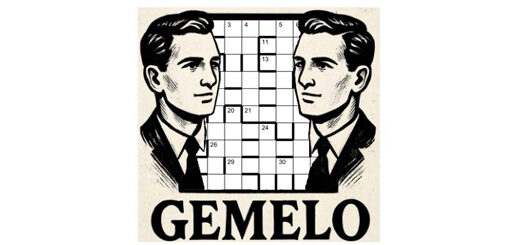
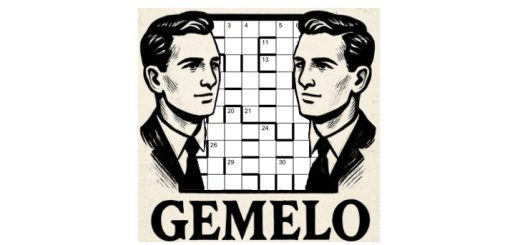
Gemelo 3 Plain
Difficulty rating:  (4 / 5)
Based on the first three Gemelo puzzles, I will certainly have to recalibrate the difficulty meter. This one was, I thought, the trickiest of the trio, with the NW corner involving several challenging clues. After the setter’s self-imposed constraints of the previous puzzle, it was good to see him being able to freely deploy the alphabet in both clues and answers, and to include the odd anagram and ‘hidden’; as previously, there were relatively few unfamiliar words or phrases in the grid, but a number of wordplays that needed plenty of teasing out. An unusual feature of the grid was the presence of two fully-checked six-letter entries, something I can’t recall ever having seen before in a plain puzzle.
I have selected what I thought were the most interesting/challenging clues for comment, but if there are any others which you would like me to cover just let me know.
Incidentally, I see that the results of the first Azed comp in its new form have been published. I submitted what I thought was my best entry for a ‘plain’ comp for several years, but that isn’t saying much, so perhaps it should have come as no surprise to see my name conspicuous by its absence from the list. I thought that the published clues made interesting reading.
Setters’ Corner: This week I’m going to look at clue 21a, “Hand over newspaper with extremely elusive tennis score (7)”. A three-letter slang term for a hand (on similar lines to ‘flipper’) contains (‘over’) the two-letter abbreviation for a newspaper with a distinctive ‘light salmon’ hue (a bit of a theme emerging here) and the outermost characters (‘extremely’) of ‘elusive’.
If there were any doubt over the authorship of the puzzle, this clue alone would have proved conclusively that it was not the work of Azed. Firstly, we have the use of ‘over’ to indicate containment. I see this quite often in puzzles, and the Listener editors allow it, presumably based on the sense given by Chambers of ‘from side to side of’. It’s not an indicator that Azed ever uses, and I can’t think of a real-life example where ‘A over B’ indicates the containment of B by A.
Secondly, we have one of Azed’s bêtes noires, the use of ‘extremely’ for letter selection. In the slip for 1186, he wrote, “I have noticed a growing tendency among crossword setters to use “extremely” to indicate the first and last letters of the following (or preceding) word, but can see no justification for it. ‘Extremely’ means ‘in an extreme way; very’ and I can’t equate that with an instruction to the solver to take the extreme letters of a word.”
That’s not to say that these indicators should not be used by setters – they will be allowed by many editors, and since they appear regularly in puzzles one could reasonably argue that irrespective of their soundness they are part of the cruciverbal lingua franca and no less fair to solvers than, say, ‘artist’ for RA. Personally, I need to feel that there is at least some justification for the use of a particular indicator, and therefore I won’t use either of these ones myself, but it is very much a matter of individual choice.
Across
9a When we have sheets of paper and pen, hiding tablet (6, 2 words)
If this was your first one in, kudos! The only UK newspaper with a one-letter name (‘paper’) is followed by a word meaning ‘[to] pen’ which contains the single letter representing the sort of tablet that your parents certainly wouldn’t buy for you to take to university. The answer is (3,3), and the definition is sneaky.
11a Intersection I found in opening year (7)
The letter I (from the clue) is found inside a five-letter word for an opening (of the sort that might be ‘yawning’ in purple prose) followed by the single-letter abbreviation of the Latin word for ‘year’.
12a Pit yielding foot bones (4)
The anatomical term for a pit or depression (the Roman word for a ditch) surrenders (‘yielding’) the single-letter abbreviation for ‘foot’.
16a End of ebony table trimmed for conference venue (5)
The last letter (‘end’) of ‘ebony’ and a five-letter ‘table’ with religious connotations missing its last letter (‘trimmed’) combine to produce the name of a Crimean resort which was catapulted to fame by Stalin in February 1945.
17a Lazy lump following Sabbath by mistake (8)
A three-letter word for a lump (or a lofted tennis shot) follows the usual abbreviation for ‘Sabbath’ [🦇RIP Ozzy🦇], with a four-letter word for a mistake of the schoolboy kind being tacked onto the end.
18a Order to undo softening effect of water, as it were? (6)
The last four letters of the answer form a word which means ‘to soften by boiling or soaking’, while the first two are a prefix ‘Indicating a reversal of process’, hence the word as a whole might fancifully (‘as it were?’) mean ‘to undo [the] softening effect of water’.
34a Pitch extremely high, formerly missing opening to throw (6)
A (1-2) term for ‘the highest pitch of anything’ precedes a word meaning ‘formerly’, deprived of (‘missing’) its first letter (‘opening’).
35a First – but not second – brand by Open University swiftly dismissed (12, 4 words)
A (6-2-4) adjective meaning ‘supreme’ or ‘unsurpassed’ (‘first’) without the word SECOND (‘but not second’) and a four-letter word meaning ‘[to] brand’ (eg with a hot iron) follow the abbreviation for ‘Open University’, thus producing the (3,2,4,3) answer. The enumeration here tells us that we cannot expect Gemelo to let us know when an answer includes an apostrophe; if hyphens and accents are ignored in enumerations, it seems reasonable that apostrophes should be treated similarly, although Azed was never sure whether to mention them or not.
Down
1d Musical film’s John and Edward (6)
This one is pretty devious – having got the last two letters from ‘Edward’, I guessed the ‘musical film’ but struggled to work out how the rest of the wordplay worked, until I realized that the definition was just ‘musical’ and “film’s John” equates to the surname of the titular character in a ‘neo-noir action thriller film series’ (Wikipedia’s words). The name seems appropriate, since I suspect that the films would get on mine.
2d Outdated operation bypasses cover over kidneys (5)
One of the hardest clues in the puzzle, where a three-letter obsolete (‘outdated’) word for ‘use’ or ‘operation’ is removed from (‘bypasses’) an eight-letter word meaning ‘to again provide cover against risk for’ (ie ‘cover over’). This name for the kidneys was used in medical circles well into the eighteenth century. As Sir John Floyer wrote in his essay on the art of feeling the pulse – and improving the technique using his special pulse-watch, available now on Amazon – “The Pulse of the ????? (or of the serous Constitution) is naturally profundus, ’tis compar’d to Hair dip’d in Water.”
4d Cry about bleak part of London (7)
A three-letter word for the cry of a cat or a gull is reversed (‘about’) ahead of one spelling of a word for the bleak, a small fish.
6d Lend a little to overturn highway (7)
A three-letter word meaning ‘[to] advance’ or ‘[to] lend’, the letter A (from the clue), and an informal word for a small amount are all reversed (‘to overturn’), the result being the sort of highway that is free of potholes but is limited to electric traffic (so only a bit like the M6toll).
8d Stoned through drinking a pop (6)
My favourite clue in the puzzle, a two-letter word for ‘through’ contains (‘drinking’) a word meaning ‘a pop’, as in ‘raffle tickets two quid a pop’. Chambers confirms that the definition is entirely valid.
13d Antelope, for example, consuming inner bark from the base (7)
A three-letter word meaning ‘for example’ contains (‘consuming’) a reversal (‘from the base’) of a word for inner bark which could also have been indicated by ‘fish’ or ‘musical instrument’.
15d I never crack up and stay youthful the longest? (7)
A (3,4) phrase which would seem to come to the same thing as ‘[to] stay youthful the longest’ leads directly to the answer.
22d Opposition caught old men’s blunder (7, 2 words)
The first part of the answer is a four-letter homophone (‘caught’) of a word meaning ‘opposition’ or ‘enemy’, while the second part is the three-letter plural of a two-letter word often indicated in cryptics by ‘father’ or ‘old man’. The latter word is, in fact, a homophone for the ‘old man’ word, but ‘Opposition caught old man’s blunder’ wouldn’t work because an indicator (here ‘caught’) can operate on the text preceding it or the text following it, but not both. For the wordplay to be sound the clue would have to be something like ‘Opposition old man caught blunder’, but there’s no obvious way to shuffle the words to produce a meaningful surface reading.
27d African rhino in Leicester city centre? (5)
Since I used to work in an office in the centre of Leicester, I know what the postcode for that area is, although those outside the UK might not. The number part which follows the two letters needs to be turned into the corresponding word, the result being an African monetary unit (‘African rhino’).
29d Wild revelry raising temperature for Beastie Boys? (4)
A four-letter word for ‘wild revelry’ has the usual abbreviation for time moved upwards (‘raising’) to produce the sort of performing unit exemplified by the Beastie Boys or, for those of a certain age, The Bachelors.
(definitions are underlined)
Happy to have got to the end of this, but I was hoping for a wee explanation of the two letters which appear to represent “space” in 20 Down. Is it a printing thing?
8
Hi Peter
Yes, ’em’ and ‘en’ are printing terms, with an en being half of an em. Strictly speaking they are units of measurement rather than spaces, so a space with a width of one en is an ‘en space’, although convention dictates that both can be indicated in cryptics by ‘space’. In a noisy print room, it would have been well-nigh impossible to differentiate between “put an em in” and “put an en in”, so the em was known as ‘mutton’ and the en as ‘nut’. Hence you could come across ‘mutton’ for EM in cryptic clues, and you are quite likely to see ‘nut’ for EN (these are more accurate than ‘space’).
Thank you. Highly (and remarkably) informative, as always.
Good puzzle and great help. I agree re difficulty. Less repetition and giveaways than Azed. Can you explain the grammar of winning clue in last Azed clue comp. Something went adrift I fear.
I think it’s a very good clue, but you have to imagine a comma between ‘ends’ and ‘for’. ‘For’ means ‘because’ in the surface read, but the comma has to be elided for the cryptic wordplay to work.
Leaving out the comma isn’t ungrammatical.
Points taken. Thank you.
However, you’ve picked up on the weakness (but not unsoundness) in the clue, the cryptic reading being the natural one and the intended surface reading requiring an unexpected pause between ‘ends’ and ‘for’. Misdirection based on alternative readings works the other way around.
I’m fairly sure it’s not the first time that JC has applauded a competition entry that’s taken the sort of liberty that he likely wouldn’t use in his puzzles. I preferred it to the 2nd and 3rd, anyway. I haven’t seen the VHCs yet, just what was in the paper.
Interesting to hear about your clue, Doctor. I suppose it’s just possible you have a HC having been marked down for a grid error, but I still have doubts about the new online submissions. I kept getting told that my name was not in a valid format (tried caps and lower-case) and just gave up. I have quite an old PC and my browser isn’t up to date, so maybe it’s that.
I’m in Much Puzzled’s camp, not being a fan of loose definitions. To justify use of the plural in 22, shouldn’t the apostrophe should follow mens? (mens’). “Old man’s” would have been much clearer. Is there any justification for “of” in 9, apparently a superfluous connection? I’ve found Gemelo’s opening trio tough, especially this one, but there is much to appreciate in his clues.
Hi Tim
I would always tend to favour the innovative over the dull (and there was plenty of the former in this puzzle, I’m pleased to say), but only if it is fair to the solver. I think the definition in 9a pushed the boundaries, and then some, with the meanings given by Chambers for ‘sheet’ not offering much support. Like you, I don’t care for that ‘of’, as I’m not comfortable with linking words being used to deceive; had it been, say, ‘of wood’, leading to TREEN in the wordplay, that would have been an entirely different story.
With 22d, if it wasn’t going to be a complete homophone I would have preferred the “old man’s” that you suggest. There isn’t a problem as such with “old men’s”, which you can interpret either as “PAS'” or “PAS is” (both work), but it seems to gratuitously mislead rather than to misdirect (I’ve seen ‘papas’ used in real life, but ‘pas’?)
Thanks Doc. I now see the purpose of the apostrophe (indicating “is” rather than possession), but agree that it is gratuitously misleading. Partial homophones would never get past The Listener editors. Like you, I would consign homophones to Room 101, along with another pet hate which is the overblown comp. anag. & lit.
Agreed – and neither group should ever be aloud to escape.
You’re on fire today. That’s a grate joke.
Kudos to anyone who knew 7D.
…but kudus to those who knew 13d 🦌
Oh, I keep herds of both of these especially for their luxurious fleece.
🤥
Judging by the lack of comments this week, I presume that everyone else has found this as difficult as I did. Finally managed to complete this but am not convinced by 26A and, whilst I have the name of the “explorer”, at 28A I cannot disambiguate the wordplay. Ditto for 5D.
Don’t like the homophone indication, caught, at 22D; and I’m not happy that so many of the definitions seem to be “examples of” rather than something more precise. e.g. 10A, 24A, 28A.
Very tough puzzle!
Hi MP
I agree about the toughness – I could easily have rated it as 4.5/5, but that wouldn’t have left me much room for manoeuvre in future. I have no idea what Gemelo’s brief was, but even allowing for the extra difficulty associated with an unfamiliar setter this was considerably tougher than any plain Azed of recent years. I do have concerns that less experienced solvers might be put off, although I have no evidence to support that.
I thought that the double definition in 26a was ok, although on reflection neither definition is perhaps entirely accurate. In 28a, ‘dropping round for a’ indicates which letter must be lost; 5d is a charade of two two-letter words. I don’t use homophones myself, but if you accept ‘heard’ then ‘caught’ (‘catch’ = ‘to hear (informal)’) seems equally good.
And the 1/4 hit the Notes overnight! Thanks again Doc.
22D: Unless my FU are wrong – appropriate for my feelings after several hours on this one – I have the answer. I’m not even convinced that my two letters for “old man” are correct, though, since the clue says “old men’s”.
Hi Jim
You’re correct with those letters. The first part of the answer is a homophone of a word meaning ‘opposition’ or ‘enemy’. The second part is not a homophone, but the plural (three letters) of a two-letter word often seen in cryptics answering to ‘father’ or ‘old man’.
Hope that clears things up. I’m going to add that clue to the notes.
‘Caught’. Yes, I see it now, and the plural. Thank you.
I’m in Oz and we have Sunday pancakes at about 08.00. Gemelo comes in at 09.00 (UK midnight). I’m the kitchen porter but got nowhere near the dishwasher (still in dressing-gown) till 13.00. Fortunately, my wife is very understanding. I suggest that we have a superb 75% Azed replacement, and that it is really good that the Doc is happy to stay around. He perfectly explained 3/4 things that confused me and the 1/4 is pending. I expect I’ve overlooked something that is pretty obvious when one is shown the path.