
Notes for Gemelo 1
There are usually one or two points of interest in an Observer barred puzzle, and here we pick them out for comment. Please feel free to add your own questions or observations on any aspect of the puzzle (including clues not listed below) either by using the comment form at the bottom of the page or, if would prefer that your question/comment is not publicly visible, by email.
Gemelo 1 Plain
Difficulty rating:  (3.5 / 5)
First things first. In today’s Observer there is a splendid article centred around Azed which also includes pieces about the other people involved in getting the barred puzzle to us on Sunday, including Colin Thomas, aka Gemelo. It can be found at:
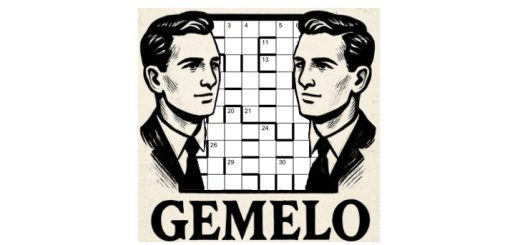
A quick look at the grid will confirm that we have a new setter, since there are four eight-letter entries with three unches (this is generally considered allowable, but Azed would never have more than one third of the letters in an entry unchecked), as well as a pair of fully checked four-letter entries (rarely, but occasionally, seen in Azed grids). Adjusting to a new setter’s style invariably takes time, so I’d be surprised if Azed regulars didn’t find this a bit tougher than an Azed of mid-range toughness. Since it’s the first of the series, I’ve assessed the difficulty rating against an average plain Azed. I hope that solvers noted the apposite letters in NW and SE corners of the finished grid. Overall, this struck me as a very polished début puzzle.
It wasn’t an Azed, of course, but the clues seemed generally very well constructed and sound, with some nice definitions, and there were a few easier clues to get the solve started. There were considerably fewer obscure words in the grid than in a typical Azed; on the other hand, some of the wordplays seemed pretty tricky, although that may be down to unfamiliarity with the setter’s little ways rather than intrinsic complexity. I’ll be interested to hear what other solvers thought of the puzzle. For the next three weeks I plan to do these notes exactly as I would for Azed; depending largely on the views of readers, I will then continue on that line, do notes only for the Azed puzzles, or do something different for the Gemelo ones. I’ll be guided by you! And by the setter, from whom it would be great to hear.
Setters’ Corner: This week I’m going to look at clue 1a, “Rector opening loved one’s mail (6)”. The single-letter abbreviation for ‘Rector’ is contained by (‘opening’) the sort of ‘loved one’ that you might associate with Stevie Wonder or Manhattan Transfer, to produce a word answering to ‘mail’ (though neither Royal nor electronic). The point of interest is the definition, specifically the fact that if you look up ‘mail’ (of the right type) in Chambers, it gives you the answer, just as, say, ‘fake’ would lead you straight to ‘cook’. This is something that setters try to avoid where possible; the reverse, however, where a dictionary entry for the answer matches the definition in the clue, eg ‘cook’ as a definition for FAKE, is desirable. That said, it is really only a problem with unfamiliar words, which the solver is likely to have to look up, eg ‘paroemia’ as the definition for ADAGE; ‘mail’ and ‘fake’ are words which will be familiar to the solver, and if they are going to look up every such word in Chambers on the off chance of finding an answer or two, then good luck to them.
Across
9a Walk around that is certainly overacting? (8)
A four-letter verb with many senses relating to mobility, including ‘walk, carry oneself [a good trick if you can do it]’, is put around the usual two-letter representation of ‘that is’ and a two-letter informal word meaning ‘all right’ or ‘certainly’. The answer is a relatively new addition to Chambers; whether ‘overacting’ quite describes it is perhaps open to question, but I’d struggle to suggest anything better that doesn’t run to several words.
11a Where I can be seen in conversion course? (6)
The position of the letter I in the word ‘conversion’ needs to be expressed using a (5,1) phrase, thus describing ‘where I can be seen in conversion’. The ‘course’ is the one I like best, particularly when cream or custard are involved.
13a Near 1ac: Rolling Stones (5)
There is a spot of deceptive capitalization in this clue, where the two-letter abbreviation for ‘near’ and the letters IAC (‘1ac’) need to be reversed (‘Rolling’).
16a 1930s comedy eludes publisher (8, 2 words)
This is a charade of a five-letter word meaning ‘eludes’ and the initials of the publisher for whom a certain Jonathan Crowther worked for over 30 years. The (4,4) comedy is of the cinematic variety, featuring Rufus T Firefly and lines such as “I could dance with you until the cows come home. On second thought, I’d rather dance with the cows till you come home.” It sounded funnier when Groucho said it…
23a Academic fellow mostly hated funny tie (8, 2 words)
A four-letter ‘academic fellow’ deprived of his last letter (‘mostly’) is followed by an anagram (‘funny’) of HATED. The answer is (4,4), and the definition is nicely disguised.
26a In East London, mistake yard for where parliament sits? (6)
When you see ‘East London’ in a clue, it’s either there to flag a South African word or to indicate that the initial H of a word should be dropped, Cockney-style. Here it is the latter, with a six-letter word for a glaring, and typically amusing, mistake losing its aspirate and having the usual abbreviation for ‘yard’ tacked on the end. The definition is pleasingly oblique.
29a A eulogy, primarily, welcomed by god? (5)
An &lit, where A (from the clue) and the first letter of ‘eulogy’ (‘eulogy primarily) are contained by the name of a god famous for his pipes and his paperbacks. The whole thing stands as a definition of the answer, and not a bad one at that.
30a Representation of Jesus’ heart replaced by high priest? Remains to be seen here (6)
The ‘representation of Jesus’ is a character linked to witch and wardrobe whom CS Lewis described as a possible answer to the question “what might Christ become like if there really were a world like Narnia and He chose to be incarnate and die and rise again in that world as He actually has done in ours?” His middle letter (‘heart’) is replaced by the standard abbreviation for ‘High Priest’, the answer being hyphenated, 3-3.
Down
1d Principal tackling a commotion, reversing tick? (8)
A four-letter word meaning ‘principal’, now usually seen in compounds with ‘enemy’, ‘bishop’ etc, contains (‘tackling’) A (from the clue) and precedes a reversal of a three-letter word for a commotion or racket.
10d Coolness in A Level after dropping university for nothing (6)
A (from the clue) is followed by a five-letter word meaning ‘level’ or ‘vertical’ wherein the usual abbreviation for ‘university’ has been replaced by the single-letter representation of ‘nothing’ (‘after dropping university for nothing’).
14d People who’ve come to break up pottery (9)
A four-letter word for the total number of people who’ve come to, say, a football match is put inside (‘to break’) a word meaning ‘up’ in the sense of ‘well-informed’.
17d Somerset capital gets even (8, 3 words)
A three-letter abbreviation for ‘Somerset’ comes before a two-letter printer’s abbreviation that equates to ‘capital’ and a three-letter word meaning ‘gets’ or ‘possesses’.
20d See medic dropping head a little lower to eat? (6)
The usual single-letter abbreviation for ‘see’ is followed by a six-letter word for a medic, or at least someone who makes people better, from which the first letter has been lost (‘dropping head’). The definition did make me wince slightly, but the way that it is integrated into the surface reading of the clue as a whole is a fine example to budding clue writers.
21d Drink after getting left in Scottish enclosure (7, 2 words)
A (1,2) French expression meaning ‘in the manner of’ (ie ‘after’) and the usual single-letter abbreviation for ‘left’ are contained by a Scots word for an enclosure. The answer is (4,3) and has long been the subject of a UK campaign.
26d Obvious negative when cycling (4)
I wrote a clue a few days ago using the two four-letter words involved here (“Frank certainly not letting leader down”), so I got this pretty quickly! An interjection which expresses an unequivocal negative is ‘cycling’, which in this instance means that just one letter is moved from the start to the end.
27d Almost edged equal to count (4)
A six-letter word meaning ‘almost’ has its first and last letters removed in order to produce the solution. I’d not seen ‘edged’ used before for this purpose, and I won’t be adding it to the lists on this site – Chambers does give a meaning of ‘edge’ as ‘to trim the edge of’, but that is what you might do to a lawn, and doesn’t involve removing the edges. OED gives no sense which hints at edges being taken off. Of course, I could have got the intended parsing wrong.
(definitions are underlined)
Really enjoyable puzzle.
Hope I’m not giving too much away even at this late stage, but if Gemelo wanted to use the solution at 16a again with a different clue, he could just change 1930s to 1920s – although it would lead to a lot of people complaining about what they think is a mistake!
Nice! I’m not sure that I was aware of the ‘Stan Laurel and Oliver Hardy’ 1927 short film which seems to have an interesting history. I see that the supervising director was one Leo McCarey, who directed the Marx Brothers film of the same name six years later.
It’s a good deceptive question for a quiz, as long as you’re able to maintain some distance between you and the angry punters.
See also:
In which sitcom did Robin Williams first appear as an alien from the planet Ork?
In which BBC sitcom starring Ruth Jones did a main character first use the phrase What’s occurrin’?
I won’t lie, I don’t know the answers.
Another would be “In which sitcom series did Norman Stanley Fletcher first appear?”
Presumably Seven of One, unless a character of the same name was in something else. The series also had the pilot for Open All Hours, of course, and less successfully a poor Laurel & Hardy update co-starring Roy Castle. (I have the DVD!) And we’ve come full circle!
(The character Mork first appeared in Happy Days, and Steve Coogan used the phrase “What’s occurrin’?” in Saxondale, in which Ruth Jones plays his girlfriend. I’m guessing it was her phrase in real life and he decided to use it.)
Tidy.
Enjoyable first outing for Gemelo. I’m struggling with 32ac. I have NELLIE as ‘weakling’ but can’t make it fit the clue – I assume I’m in error.
Hi Ed
No, you’ve got the right answer. There is another ‘nellie/nelly’ in Chambers, rhyming slang for ‘life’, specifically found in the phrase “not on your nellie”.
As Eric Partridge wrote about such slang, “The trouble begins when part, usually the latter part, of the rhyming phrase is omitted, as so often it is, as in ‘not on your Nellie’ for ‘…Nellie Duff!’ = ‘not on your puff’ = ‘not on your life’ or ‘most certainly not’ or, less politely, ‘like hell, I will!’.”
‘Puff’ is itself slang for ‘breath’ and, by extension, life. I can only suppose that Nellie Duff was a friend of the equally mysterious Rosie Lee.
I imagine that not many people can claim to have done _every_ Azed right from the very first, but this week we can be proud to make that very claim about Gelato —oops— Gemelo.
Yes, we have joined an exclusive club that in three days’ time will permanently stop accepting new members. Mmmmm, gelato…😋
Incidentally, for anyone wanting to venture back to March 1972, Azed #1 can be found here and the solution here.
Hi
Smooth transition, I think! (Both of you.)
For 9ac, split overacting – the answer’s derivation could be described as something done (usually execrably, in my experience) over music.
That’s good to hear – thank you.
I just don’t feel that ‘overplaying’ quite works for the word that you’re referring to, or ‘overboard?’ for SURFER. I think they all need a pronoun to represent the answer – “it’s overacting?” or “one’s overboard?”. But I’m all for innovation in definitions, particularly of tricky words like the one at 9a, so I’m definitely not complaining – I was in no doubt that I’d got the right answer.
Thanks for the link to the Observer article.
I will no longer be bothering with the Everyman puzzle now I know that the setter thinks it’s acceptable to put his feet on a public bench (while himself sitting on something protective to keep his clothing clean).
Yours sincerely
Disgusted of Tunbridge Wells
I enjoyed this Gemelo puzzle. Although fewer obscurities feature, the clueing is enjoyable and made for a satisfying solve. I wonder if periodic “specials” such as ‘Carte Blanche’ and ‘Playfair’ will continue?
Hi Blake
Since Azed will still be setting the competition puzzles, I would expect the ‘specials’ that involve gimmicked clues (eg Spoonerisms, Printer’s Devilry, Letters Latent) to largely come from him. There’s no reason why those can’t appear as non-competition puzzles, although historically the non-comp specials have tended to be Carte Blanche, Eightsome Reels etc. Let’s hope that Gemelo will be able to boost the ‘specials count’ a bit, and perhaps even introduce a novelty or two of his own?
PS When I wrote in an earlier comment about setters needing to ‘play fair with their clues’, I wasn’t sending out a request for a particular sort of special 😀.
Thanks for the reply. I’m looking forward to seeing how the barred puzzles develop with Gemelo on board.
Bit of a shock this week. Thanks for all the explanations. Hints for 8 and 19 wd be aporeciated !
Hi Iain
Ah, it’s ‘The Shock of the New’, an expression that hadn’t been coined when Azed started!
8d “Readers of old article from Hamburg“. A double definition clue, but only the first, an obsolete (‘of old’) word for what you read with, is in Chambers. The second is an article (in the grammatical sense) in the German language (‘from Hamburg’).
19a “Nuclear craft hiding fault in maritime paperwork“. The single-letter abbreviation for ‘nuclear’ and a familiar three-letter word for ‘craft’ or ‘practical skill’ contain (‘hiding’) a four-letter word for a fault (as in ‘my only ???? is eating eight éclairs a day’).
Hope that helps
Hello Doc
Didn’t know anything about the change of setters but after a little sleuthing, all became clear. So fearful of not having an Azed every Sunday morning.
Just finished the Gemelo (anything to do with a ‘twin’ for Azed?) and thank goodness for ‘ersatz’ which got me started. I think G will be great – nearly as devious as Azed – and will become familiar with his little ways, eventually.
I solved 11a as ‘afters’ but didn’t know why so looked in your clinic hoping you would be carrying on in the same vein as with Azed … Thank you.
Who really can fill Azed’s boots? Think we have a good one here .
Hello Ursula
Yes, I think any new setter takes a bit of getting used to, but if they play fair with their clues that makes the process a lot easier…and much more fun! Good to hear that you enjoyed the puzzle. The Observer article (link towards the top of this post) explains the choice of pseudonym.
Oh, thanks for pointing me to the article… Should have read it first!
Pleased Azed can take it a little easier and looking forward to more Gemelo puzzles. Can’t help thinking of Gremlins, I don’t know why😊
…with perhaps just a hint of Gruffalo? 😃
Phew! A puzzle of two halves – with the right hand side being much easier, although I would never have understood the wordplay in 30A without your hints.
Especially liked 18D and 33A though.
I agree that the wordplay seemed a little trickier than Azed’s but, as you say, it may just be unfamiliarity. For example, I don’t recall Azed using the type of wordplay in 11a but I could be wrong. As a result, it took it me longer than usual.
Getting the letter in the SE corner struck me as clever. It’s a shame though that the letter in the SW corner wasn’t a D.
I have I_ULGE for 15 and nothing seems to fit. Have I gone wrong somewhere?
Hi Matty H
Yes, your first letter is wrong, since 5d ends with the abbreviation for ‘executive committee’.
Hope that helps, but let me know if not.
Thanks!
I am pleased that the print version has reverted to the layout used for many years, with a clear distinction between the thin lines for the squares and the thicker bars. For the last few weeks the layout was horrible, with thicker lines for the squares. The overall effect was like looking at a manuscript with a peculiar font which distracted the eye from the content.
I imagine that the change in setter and the consequent publicity led someone to look at the layout. Fortunately, they kept the one good part of the recent layout: the larger numbers which seemed to have been getting smaller over the years – I don’t think it was my eyesight!